
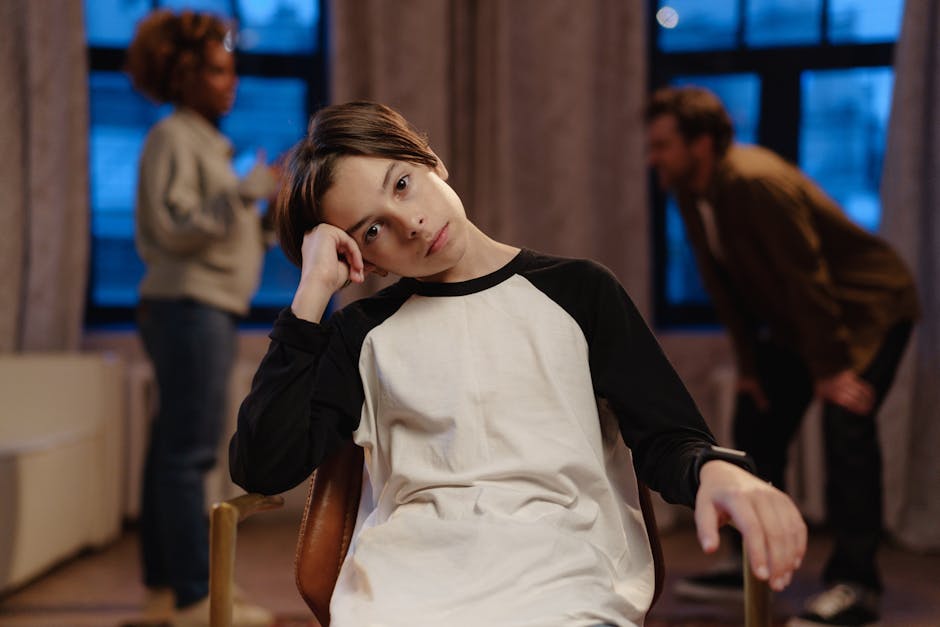
Children learn from what adults avoid, how our bodies tighten, and which subjects make a room go quiet. Even without an explanation, they may treat those signals as instructions about what is dangerous, shameful, or unsafe to discuss.
In 1985, developmental psychologist James Sorce and his colleagues placed one-year-old infants on a “visual cliff,” a glass-covered surface that created the appearance of a sudden drop. The surface was physically safe, but the visual information was uncertain enough to make the infants pause.
Their mothers stood on the other side. When a mother showed joy, most infants crossed the apparent drop. When she showed fear, none crossed. The researchers documented the experiment in the journal Developmental Psychology as a study of emotional communication between mothers and infants.
The infants did not receive a lecture about risk. They watched a face.
Children read what adults leave unsaid
A child may not know why a parent stops answering when a certain relative is mentioned. She can still notice the lowered voice, the shortened reply, and the abrupt change of subject.
A child may never hear that money feels frightening. He can still observe the tense conversation after a bill arrives, the secrecy around purchases, or the way ordinary requests suddenly produce sharp answers.
These moments do not prove that a child will develop a lasting fear. Temperament, age, relationships, and later experiences all matter. Children also misunderstand signals. A parent’s silence may come from fatigue, privacy, grief, or a desire to wait for the right time.
Yet silence does not create an empty space. Children often fill it with whatever explanation is available to them, and young minds can place themselves at the center of events they did not cause.
The visual cliff experiment gives us a useful picture. The infants faced uncertainty, then looked toward a trusted adult for help interpreting it. Children continue doing versions of that long after infancy. They watch whom we avoid, which questions end conversations, and whether difficult feelings can be named without punishment.
Private fear can shape a public home
Ordering Your Private World directs attention toward the inner life because public steadiness can become fragile when private character, attention, and spiritual life receive no care. That principle reaches beyond personal productivity. An adult’s unexamined fear can become part of a household’s emotional atmosphere.
Fear itself is not a moral failure. Scripture repeatedly makes room for people who tremble, grieve, ask for help, and struggle to see the next step. Courage grows through faithful action in the presence of fear. It does not require pretending that fear has disappeared.
The trouble begins when avoidance becomes the family’s main response. Children may learn that conflict must be escaped, mistakes must be hidden, illness cannot be discussed, or sadness makes other people uncomfortable. They learn the pattern before they understand the problem.
This does not mean children need access to every adult detail. Some information belongs in private conversations, and age-appropriate boundaries protect children. Honesty can be simple without becoming overwhelming:
“We are dealing with a difficult situation. You did not cause it.”
“I feel worried, but the adults are working on the next step.”
“You can ask me questions. I may not be able to tell you everything, but I will not punish you for asking.”
Those sentences give a child context, limits, and permission to speak.
Name the signal before correcting the behavior
When a child avoids a place, person, task, or conversation, correction alone may miss the lesson underneath. Pause before calling the behavior stubborn, dramatic, or disrespectful.
Ask what the child may have observed.
Perhaps your face changed when the subject came up. Perhaps adults whispered about it after bedtime. Perhaps the child heard one alarming fragment and built a larger story around it. The goal is not to interrogate the child until a hidden cause appears. The goal is to become safe enough for honest words.
Try one calm observation: “I noticed you became quiet when we mentioned tomorrow. What part feels hardest?”
Then listen without rushing to remove the feeling. A quick “There’s nothing to worry about” can close the conversation, especially when the child already senses that something matters. A more truthful answer might be: “I can see why that felt uncertain. Let’s talk about what we know and what we do not know.”
Adults may need support too. Persistent fear, sudden behavioral changes, sleep problems, or distress that disrupts daily life deserve careful attention from an appropriate health or child-development professional. Prayer, patient conversation, and professional care can belong in the same response.
Give children a clearer face to follow
The mothers in the visual cliff study communicated before their children could weigh a verbal explanation. That same responsibility remains as children grow: our expressions, pauses, and patterns help frame what they see.
Choose one subject your household tends to avoid. Do not force a dramatic family meeting. Take ten quiet minutes first and name your own fear before God, on paper, or with a trusted adult. Decide what a child needs to know, what should remain private, and which reassuring claim you can honestly make.
Then offer one clear sentence and one open door: “This has felt tense lately. It is an adult problem, you did not cause it, and you can talk to me about how it feels.”
A child cannot be protected from every uncertainty. But when the room grows quiet, your honest presence can keep silence from becoming the loudest teacher.
Comments
No comments yet.